Showing posts with label breaking ground. Show all posts

Deep Woods Plots Worth the Effort

By David Hart

Curt Lytle had two primary concerns in the days after he settled on a 160-acre southeast Virginia farm: building a house and planting food plots. An avid traditional bow hunter, Lytle was eager to make his new oasis as wildlife-friendly as possible. That plan included food plots — lots of them. In all, he created nine at calculated locations in the pine forest that covered most of his ground.

Good Soil Sound Agricultural Principles Produce Good Soil So Food Plots Can Thrive

Most Imperial perennial blends fix
nitrogen, which can reduce fertilizer
costs for rotational crops.
By William Cousins

Whitetail Institute forage products are designed to establish and grow quickly and perform at the highest level. Here are some tips to help you keep your soil in the best possible condition so that your plantings can grow as well as they should — and help you save money in the process.

No-Plow & Secret Spot Fall Annuals that Perform Many Roles

By Hollis Ayres

Hunting season is right around the corner. When you’re deciding which Whitetail Institute forage to plant in each of your sites, don’t overlook No-Plow and Secret Spot.

A Three Ring Binder Your Prime Tool for Better Food Plots


By Charles J. Alsheimer

Developing a great hunting property requires a lot of work. Unfortunately, most landowners struggle to fulfill their dreams because they underestimate the importance of building a solid data base for their property. Philosopher George Santayana said: “Those that cannot remember the past are condemned to repeat it,” which sums up why documenting every aspect of your land management practices is so important. If you can’t remember what you did in the past, it’s hard to track your property’s progress, because as the years pass, memories fade. After all, Babe Ruth’s 60-home-run season in 1927 wouldn’t have meant much if someone hadn’t kept track of Major League home run totals through the years.

Imperial Whitetail Oats Plus

Every now and then, it pays to be lucky. And that’s just how the newest addition to the Whitetail Institute’s product lineup, Oats Plus, got started — with a stroke of luck.

Winter-Greens and Tall Tine Tubers "Let'em Eat Cake"

By Hollis Ayres

Looking for a forage that can attract deer in the fall and then have the deer pouring in during the colder months of the year? With Imperial Whitetail Winter-Greens and Tall Tine Tubers, the Whitetail Institute has you covered.

Chic Magnet is Forage "A-Lister"

Imperial Whitetail Chic magnet
By Whitetail Institute Staff

Anyone who has surfed TV channels at night and stumbled across a celebrity gossip show has probably heard of the “A-List,” a name by which Hollywood describes a small group of the movie industry’s top stars. Referred to as “A-Listers,” actors who make the cut are automatically invited to any Hollywood party, no matter where it’s held or who the host is. And there’s a reason: A-Listers make the party a whole lot better just by showing up.

Breaking New Ground

By Joe Blake
New food plots are always a challenge for land managers, but the success of your plantings is directly proportionate to the initial effort you put forth while breaking new ground. My 10-year-old son Ryan’s breathing was labored and his knees were shaking noticeably, but the barrel of his .243 was steady as he focused all his attention on the group of does across the field of Tall Tine Tubers. This was Ryan’s first year of deer hunting here in Minnesota and I chose to set him up in a blind along the edge of this new field. I knew the field was full of deer every night and that there were a handful of dandy bucks feeding on the lush leaves while checking out the numerous does using the field.

301-Pound Canadian Monster

By Bernard Fiset


I have been hunting whitetails for more than 30 years, and most of that has been in Quebec, Canada. I have chased whitetails east, west, north and south across my province without any significant sightings of big deer in all the areas that I attempted to hunt. I tried reputable outfitters and leasing property to try to kill a big deer. But nothing proved to be effective in my attempt to harvest a true mature buck.

Set Up Small Acreages for Better Harvest Opportunities

By Dean Weimer


Many modern deer hunters believe that managing a reasonable deer herd takes at least several hundred acres of prime land. And although it would be nice if we all owned and managed large chunks of whitetail real estate, that is far from reality for most of us. Moreover, I guess that leads to the next best thing: managing small acreages for better harvest opportunities. In a sense, I hit the lottery more than 14 years ago when I took a job at a local factory in my hometown.

Three Elements for Successful Perennial Plantings


By Wilson Scott

Designed to last three to five years, Whitetail Institute perennials can be the backbone of a food plot system. The three most important things you can do to get the most production and longevity from your perennials are liming low pH soil, fertilizing, and controlling weeds. Each of these is important in its own right. Moreover, cutting corners on one can also reduce your results with the others.

Everyone Wants ....Results


As the old saying goes, “Good things come to those who wait.” For some time, Whitetail Institute field testers and customers have asked the folks at Whitetail Institute to make available a deer feed supplement that they could use in their nutritional management programs. So the obvious question would be, “Why has a Whitetail Institute deer feed not been introduced?”

Reclamation Food Plots How you can turn a negative into a positive.

By Bob Humphrey

Stock dams are another good location
for reclamation plots. Just make sure
your planting addresses potential
erosion problems on steep slopes.
Ed Gaw owns a 200-acre parcel of land in western Pennsylvania. On the surface, it is nothing special; just another patch of wooded ground, a place to hunt and spend time outdoors. However, it overlies a formation of sedimentary rock known as the Marcellus Shale Formation, which spans West Virginia, eastern Ohio, southern New York and most of western and central Pennsylvania. Within the impervious limestone beneath this formation is a reservoir of natural gas once thought to be marginally worth the investment to recover. During the past decade, however, geologists have significantly increased their assessments and now estimate the formation contains enough natural gas to support the entire United States consumption for at least two years, though estimates keep increasing.

Wading Through the Gene Pool

By Scott Bestul

Back in the 1980s, my cousins and I decided to “get serious” about improving the buck quality on the 600-plus acres we hunted in central Wisconsin. Most of us were not far removed from a farm background, so one of the first things we did was something any good farmer who wanted his critters to grow big and impressive would do: We tried to get rid of breeding age males that looked inferior. We’d have had more success herding cats.

Creative Winter Strategies for Farm Country Food Plots

By Scott Bestul

I call it March Madness, and it will start about the time people get excited about the NCAA tournament. But the insanity I refer to has nothing to do with college basketball. About this time, I will start talking to people — some serious deer guys, a few casual hunters, even the odd wildlife watcher who thinks he knows something about whitetails — and they will say the same thing. “Well, another long winter is almost gone. The deer have made it for another year.”

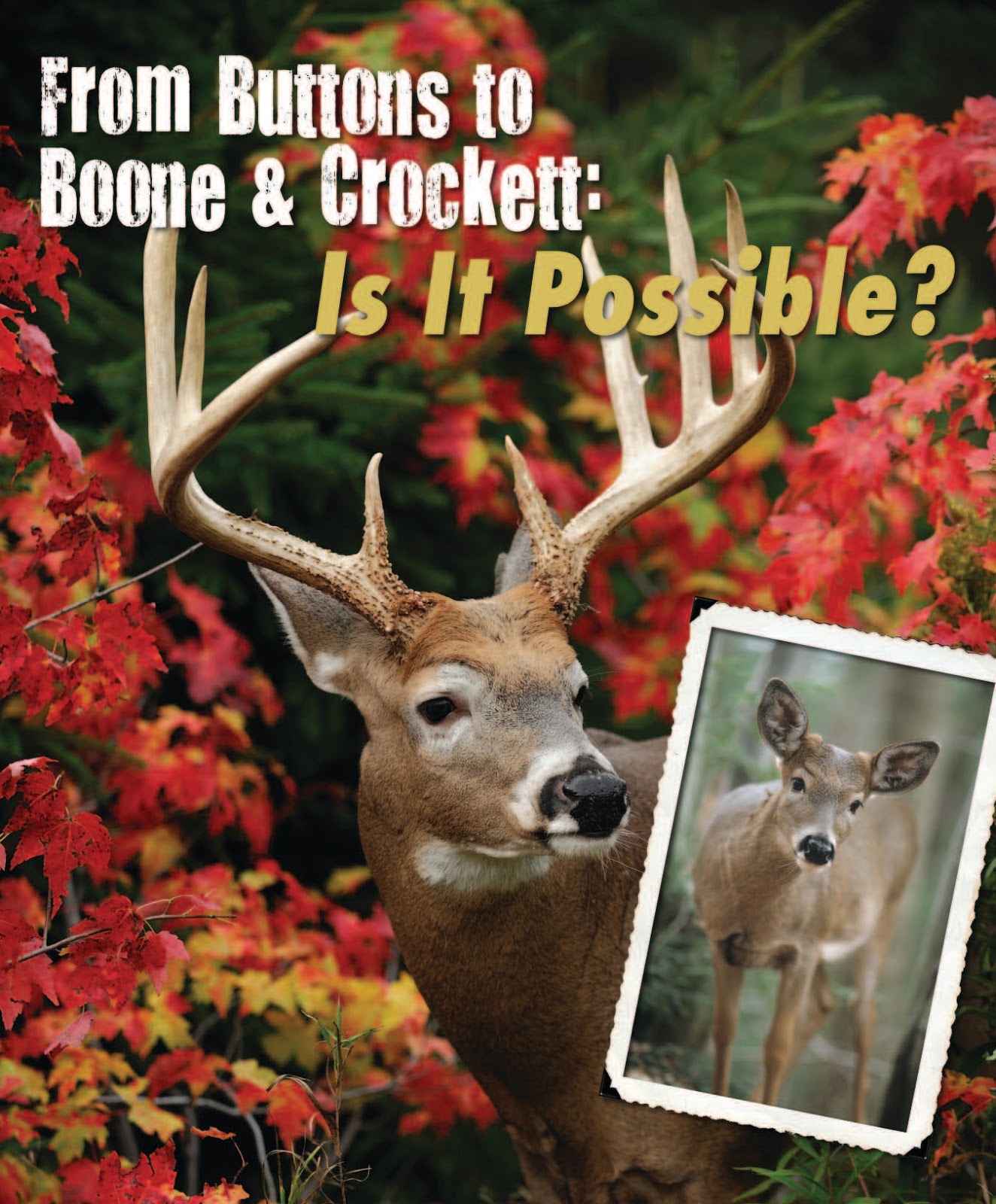
From Buttons to Boone & Crockett: Is it possible?

By Charles J. Alsheimer
As a teen, I believed age and quality food sources were the magical ingredients needed to produce a buck with the minimum 170 inches required for entry into the Boone and Crockett record book. As time passed, my thinking changed. In reality, there is no guarantee a buck will actually produce a Boone and Crockett rack. The process of getting a whitetail from the button buck stage to the B&C category is a mystical journey that includes a complex assortment of variables. It takes four basic ingredients to produce a buck with a 170-inch rack: genetics, habitat, herd management and age.

The Wonderment of Not Knowing

By R.G. Bernier
 “If life is to preserve its glamour and the heart its freshness,
we must not lose our capacity to wonder.
—Archibald Rutledge

Sitting beneath a stately oak — at least I believe it was an oak tree, with branches extended like the arms of a coddling mother not quite ready to release her grip on a boy determined to enter manhood — is where I was positioned next to Dad on my first deer hunt. Excited, exuberant and with a good bit of youthful restlessness I watched the day dawn on the whitetail forest. Each noise, every interruption was met with a renewed curiosity and the constant inquiry to my father, “When are the deer coming?” My boyhood imagination had conjured up the notion that deer would arrive upon a scheduled time, at this precise location and that is why we were indeed located where we were in order to intercept them. If it were only that simple … .

Whitetail Salad

By Joe Blake
The author is checking out a
field of Tall Tine Turnips on his
Minnesota farm; notice the tonnage
available from the tall, green
'salad' in early fall.
For pure tonnage, palatability and overall benefits, few food plot offerings excel like brassicas.

The morning sun had warmed considerably, and the frost had all but disappeared from the edges of the field of brassicas stretched out in front of me. By 10:30 a.m. I was getting drowsy and needed to perk up a little, so I stood, stretched, and eased my rattling antlers from the cut limb where they had been hanging since well before daylight. Scanning the surrounding oak woods one last time to make sure no deer were moving close by, I clashed the bone together with as much force as I could muster, and then began twisting and turning the pair together to simulate a couple of angry whitetails engaged in a pre-rut challenge. Returning the rack to its resting place I grunted aggressively several times before slipping the call back inside my wool jacket and wrapping my left hand around the familiar, worn, elk-hide grip of my 60-pound longbow.

Cooperation Vital to QDM Success

By Charles Alsheimer

Snowflakes floated to the ground as I made my way from the parking lot to the school entrance. I found the auditorium where I was to set up my projection equipment for a seminar I’d be doing. Before I could get set up several men approached and introduced themselves. They were part of a group of landowners who hoped to generate interest in quality deer management by hosting an antler round up. My role in the evening’s event was to share with attendees how a quality deer management program could provide better deer and better hunting. 

Nutrition Vs Attraction

By Matt Harper
Childhood experiences often cause behaviors that stick with us for the rest of our lives. For example, I have this weird quirk that involves eating items on my plate in a systematic fashion, nishing each portion before I move to the next. What influenced this dietary methodology is the fact that I was forced to try everything that was offered and I had to clean my plate completely. I know what you’re thinking; torturous, medieval even, but no matter how heinous the food (we are talking things like dandelion greens and cooked parsnips) I was forced to eat what was put in front of me.